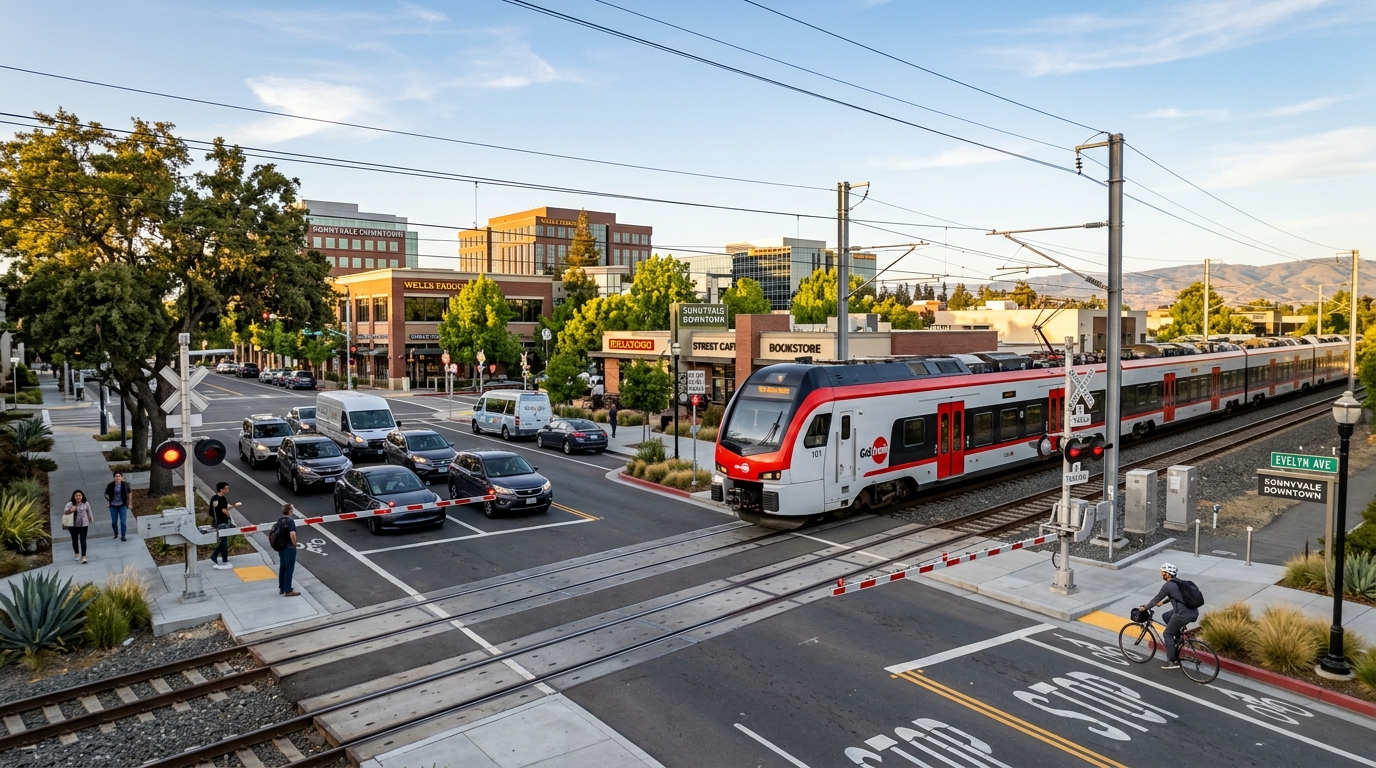
Two of Sunnyvale’s busiest connections across the Caltrain corridor could eventually look very different. The city is advancing plans to separate the railroad tracks from travelers at Mary Avenue and Sunnyvale Avenue, replacing the current street-level crossing arrangement with projects designed to reduce conflicts between trains, vehicles, cyclists and pedestrians.
The two locations are often discussed together as Sunnyvale’s Caltrain grade separation project, but they will not receive the same treatment. At Mary Avenue, the preferred plan would lower the roadway beneath the railroad tracks. At Sunnyvale Avenue, the selected concept would close the street to regular vehicle traffic at the tracks while creating a dedicated bicycle and pedestrian undercrossing.
These are major infrastructure projects, not changes residents should expect to see completed overnight. In 2026, environmental work, coordination with Caltrain and the search for additional funding remain central parts of the process.
For Sunnyvale residents, understanding the difference between the two projects is useful because each could affect local travel in a very different way.
What Sunnyvale Has Chosen for the Two Caltrain Crossings
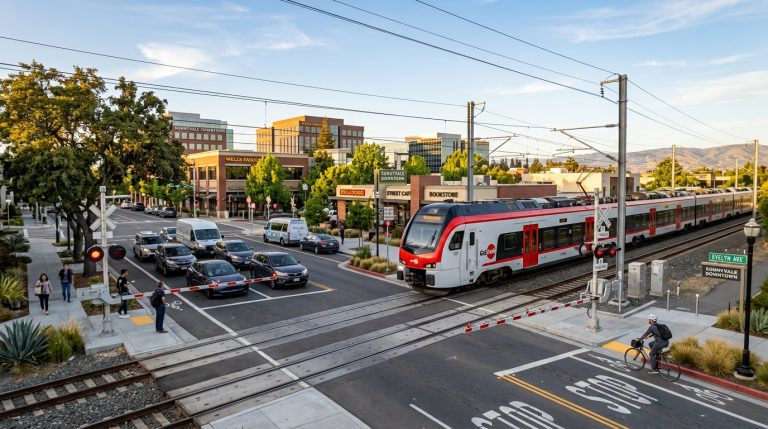
Sunnyvale currently has active street-level railway crossings at both Mary Avenue and Sunnyvale Avenue. At an at-grade crossing, road users and trains pass through the same physical level at different times. Railroad gates therefore have to stop vehicle, bicycle and pedestrian traffic whenever trains pass.
The city began studying alternatives several years ago and completed its grade separation feasibility study in 2022. Following public meetings and City Council hearings, elected officials selected a preferred project for each location.
Two Crossings, Two Very Different Solutions
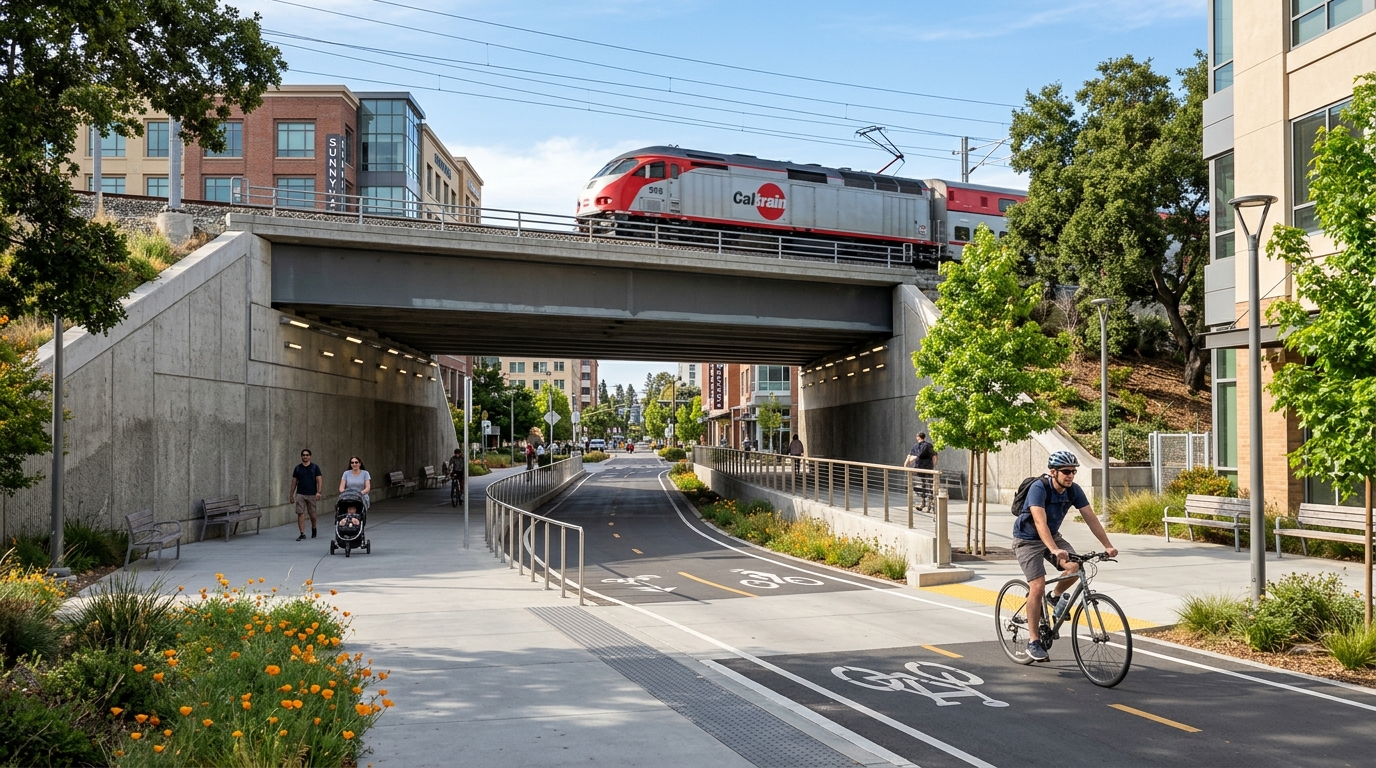
The Mary Avenue project preserves a vehicle connection across the railroad corridor. Instead of cars crossing directly over the tracks, Mary Avenue would descend beneath them. The selected concept also uses a jughandle-style roadway connection to maintain access between Mary Avenue and Evelyn Avenue.
Sunnyvale Avenue takes a different approach. The selected concept would eliminate the regular vehicle crossing at the railroad tracks and provide a new undercrossing intended for pedestrians and bicyclists. Vehicles would no longer have a direct connection across the tracks at that point.
The distinction matters because grade separation does not always mean building an enormous bridge over a railroad. Depending on the location, cities can lower a road, elevate tracks, create tunnels, build dedicated pedestrian facilities or close certain crossings entirely.
Residents following other transportation improvements may also be interested in our guide to the Sunnyvale East Channel Trail, another project intended to improve walking and bicycling connections through the city.
Mary Avenue: Roadway Underpass With a Jughandle
The selected Mary Avenue concept is called the Underpass Tunnel with Jughandle. Mary Avenue would be lowered beneath both Evelyn Avenue and the Caltrain tracks rather than forcing road traffic to stop every time a train passes.
A jughandle connection would provide access between Mary Avenue and Evelyn Avenue. That feature is necessary because lowering Mary Avenue changes the elevation of the intersection and makes a conventional street-level crossing between the two roads impractical.
The project would also incorporate facilities for people walking and bicycling. Improving those connections is an important part of the city’s stated goals for the grade separation program rather than treating the project only as a way to move automobiles.
As of 2026, Mary Avenue is the more advanced of Sunnyvale’s two selected crossings. The city is coordinating with Caltrain on a service agreement needed to advance the environmental-clearance phase while also seeking funding for later phases.
Sunnyvale Avenue: A Bicycle and Pedestrian Undercrossing
The Sunnyvale Avenue concept would produce a much more noticeable change to the local street network. Instead of lowering the roadway for cars, the plan calls for closing Sunnyvale Avenue to regular vehicle traffic where it meets the railroad.
A dedicated tunnel beneath the tracks would allow pedestrians and bicyclists to continue crossing. Planning material for the concept also shows changes to nearby bicycle and pedestrian routes so users can reach the undercrossing from surrounding streets.
This option can eliminate the direct conflict between cars and trains without requiring the much larger excavation that would be needed to carry the entire roadway underneath the railroad.
Because the crossing sits close to Historic Downtown Sunnyvale, changes here could influence how people reach downtown neighborhoods, businesses and public spaces. For more about changes nearby, see our guide to Downtown Sunnyvale, Cityline and Murphy Avenue.
Why Grade Separation Matters More as Rail Service Evolves
A railroad gate may seem like a minor inconvenience when only an occasional train passes. The calculation changes as a rail corridor becomes busier.
Every time crossing gates come down, vehicles, buses, cyclists and pedestrians have to wait. More trains can mean more frequent interruptions. Separating the road network from the railway allows each system to operate without repeatedly stopping the other.
There is also a safety benefit. A fully separated crossing removes the point where a train and a road user might otherwise occupy the same space. Caltrain identifies improved safety, reduced congestion, less crossing noise and stronger community connectivity among the potential benefits of removing at-grade conflicts.
Noise can change as well. At conventional crossings, warning systems and train horns help alert people that a train is approaching. Eliminating or fully separating a crossing can reduce the need for some of those warnings, depending on the final configuration and applicable railroad requirements.
The potential benefits explain why grade separations are being considered throughout the Peninsula rather than only in Sunnyvale.
How Sunnyvale Fits Into the Larger Caltrain Corridor
Sunnyvale’s projects are part of a much larger challenge facing communities along the Caltrain corridor. Cities from San Francisco through Santa Clara County have grown around a railroad that has existed for generations, leaving numerous places where streets and tracks still intersect at the same level.
Caltrain is now taking a more coordinated approach through its Corridor Crossings Strategy. Instead of viewing every grade separation as an isolated city project, the strategy creates a framework for prioritizing safety improvements, crossing closures and full separation projects across the rail corridor.
In the 2026 strategy, both Mary Avenue and Sunnyvale Avenue are included among projects recommended to advance through preliminary engineering and environmental clearance. The strategy also makes clear why financing is such a difficult part of the process: major grade separations can cost hundreds of millions of dollars.
What Residents Should Watch as the Projects Move Forward
The preferred concepts have been selected, but choosing a concept is only one stage of delivering major transportation infrastructure. Environmental analysis, engineering, funding agreements, utility work, right-of-way issues, final design and construction planning can all occur before a project is ready to break ground.
That means the most useful question in 2026 is not simply, “When will construction start?” It is which milestones must happen first.
Environmental Clearance Comes Before Final Construction Design
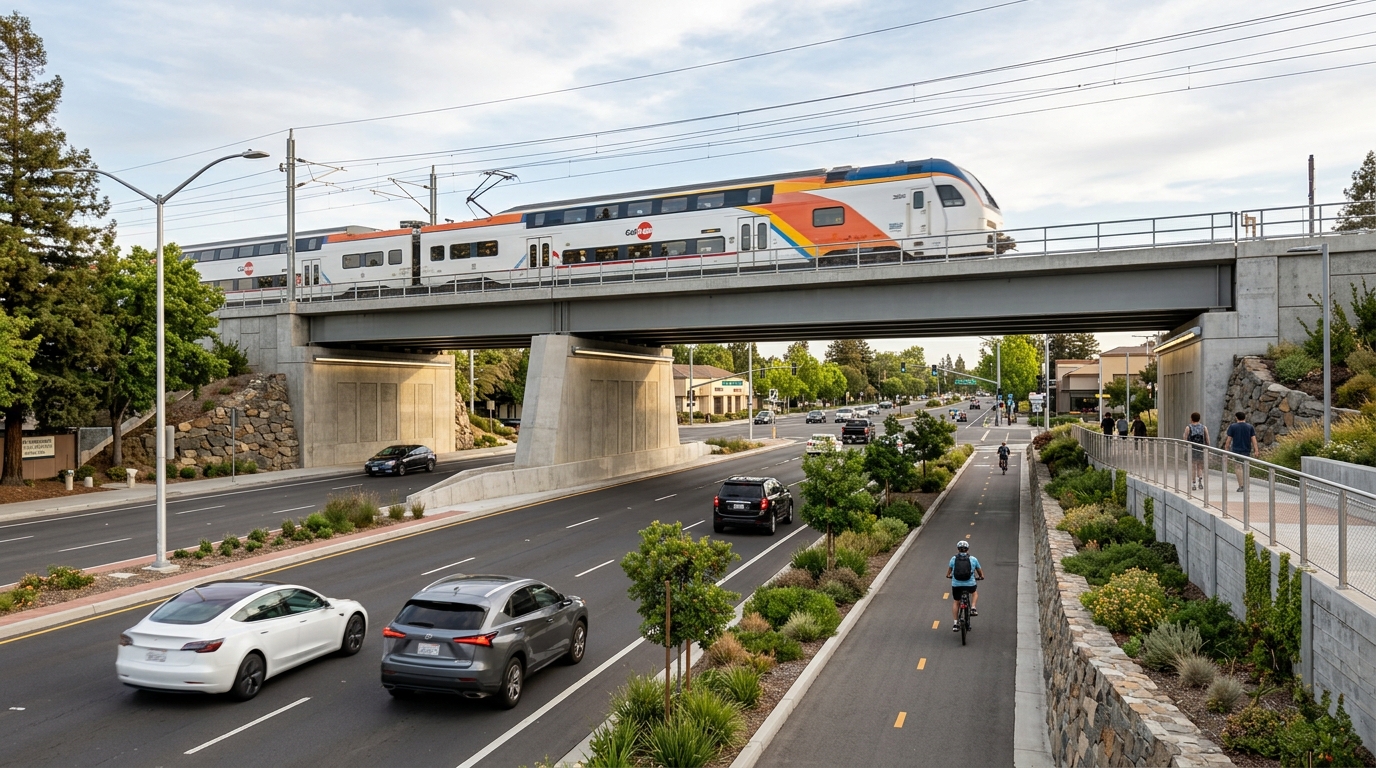
Sunnyvale says the two crossing locations will move forward as separate projects. Under Caltrain policy, Caltrain staff will manage them from environmental clearance through construction, while the City of Sunnyvale will continue to serve as project sponsor and funding agency.
Mary Avenue is currently moving toward environmental clearance. The city says coordination on a service agreement with Caltrain is ongoing. Sunnyvale is also working to secure money needed for future project phases.
The schedule for the Sunnyvale Avenue project remains to be determined. Its environmental study is expected to follow Mary Avenue rather than proceed on exactly the same timetable.
Residents looking for official updates can follow the City of Sunnyvale Caltrain Grade Separation project page.
Funding May Be the Biggest Variable
Grade separations are among the most expensive transportation projects a city can undertake because work must occur around an active railroad while roads, utilities, nearby properties and local access continue to function.
Caltrain’s 2026 corridor planning work gives a sense of the scale. Its planning-level estimate places the Mary Avenue project in a range of roughly $400 million to $700 million and Sunnyvale Avenue at roughly $100 million to $200 million. These figures are planning estimates rather than final construction contracts, and costs can change as engineering advances.
The same Caltrain strategy stresses that completion of active crossing projects depends on securing funding, which can take years. Sunnyvale therefore continues looking for funding opportunities while advancing the project-development process.
For residents, that means the selected designs are meaningful milestones, but they should not be confused with guaranteed construction dates.
The eventual payoff could nevertheless be substantial. Mary Avenue could provide an uninterrupted vehicle, bicycle and pedestrian route beneath the railroad, while the Sunnyvale Avenue project could create a quieter, lower-conflict walking and cycling connection into the downtown area. Combined with projects such as the East Channel Trail and continued walking and outdoor improvements around Sunnyvale, they form part of a broader shift toward a city transportation network that gives people more ways to move around safely.
These projects are still years away from being fully realized, and their schedules will depend heavily on environmental work, design and funding. But the key decisions about what Sunnyvale wants to build have already been made. The next chapter is about turning those preferred concepts into projects that can actually be funded, designed and constructed.